Globalization has enriched the world of emerging countries, and now neither “friendly shoring” (doing business only with friendly countries) as envisioned by Western nations nor sanctions on Moscow, which also affect those doing business with Russia, seem to deter them.
Fourteen months after the invasion of Ukraine by Moscow’s troops, the so-called international order appears to be extremely fluid, despite the emergence of new “blocs” taking shape. A new “iron curtain” has appeared and stretches along the western border of Russia, now that NATO has found a way to expand and consolidate. The Western fortress, however, appears more isolated, defending democracy against the rest of the world, which no longer seems to view it as the beacon of progress. From various perspectives, it seems that perhaps the West, including the United States, can be dispensed with.
The initial idea was to inflict harsh economic sanctions on Russia, declaring it a full-scale economic war to “bring it to its knees.” As one of the generals of that war, Mario Draghi, stated in June 2022, “Sanctions work. The International Monetary Fund predicts that the cost to the Russian economy this year will be equivalent to 8.5 percentage points of GDP. Time has revealed and is revealing that these measures are increasingly effective.” However, these predictions have been disproven, and the Russian economy has not collapsed. Why? This question has been removed from the public debate in Italy. There was an attempt to portray Russia as nothing more than “a gas station with nuclear weapons,” but this was largely propaganda, driven by distorted information about the current state of the Russian and global economies.
For years, in our dealings with Russian colleagues, we had sensed the gap between the prevailing Western narrative about Russia and what was actually happening there. The 1990s had been very tough for Russians, hit by an economic crisis similar to the one we experienced after 1929. The collapse of the USSR, the opening to the “market,” the transition to a capitalist economy had caused upheaval. In the shift from socialism to capitalism, what later became known as “shock therapy” had been adopted: severe cuts in public spending, reductions in the size and salaries of the military and police, the slashing of nearly all subsidies to industry, the privatization of mostly public companies, with potential closures or restructuring to make the production system more efficient and competitive in the markets. To liberalize the economy, the government had removed barriers to international trade, legalized the creation of private enterprises and their trade, and dismantled price controls on about 90% of consumer goods. In theory, all these rapid reforms would inflict necessary but temporary pain on the people and, it was hoped, generate a more efficient economy.
In practice, the burden on citizens was catastrophic. Shortages of goods, unemployment, the closure of large and small companies, a dismantled social security system. The massive reduction in the military and police apparatus had led to a wave of crime and violence, resulting in Russia having a homicide rate similar to Mexico and Colombia. Giant industries that no longer received subsidies began mass layoffs or didn’t pay taxes. Unemployment, once close to zero percent, albeit due to inefficient government mandates, rose to over 15%, not to mention those who were unpaid or forced to work part-time. Transitioning from a centrally planned economy with administered prices, phony privatizations awarded to dignitaries of the previous regime, to a competitive free-market jungle without protection meant poverty and a lack of basic goods for many. Ordinary people, as always, found a way to adapt: from growing potatoes on their balconies to working as part-time taxi drivers to supplement their income. Public services collapsed, and mortality increased. But what truly alarmed Russia’s long-term economic prospects was the complete failure of state property privatizations, resulting in the rise of the “oligarchs.”
The adjustment lasted at least a decade, and once embarked on the capitalist path, the recovery was relatively swift. “Western” lifestyles accompanied the growth of the middle class and income. Compared to that situation, there have been huge improvements, and a new economic and social stability underlies Putin’s political success. However, the Russian economy has not changed much: it remains a major producer of energy and agricultural raw materials. An economy that exports commodities and some manufacturing and imports technologies and consumer goods. With Europe, yes, but also with the rest of the world. In the grand game of globalization, Russia had gained its place but remained a moderately sized economy.
Then came the war in Ukraine, with the Europeans, driven by the Americans, resenting Russia’s about-face. After years of building networks of exchange—pipelines, oil imports, grain and fertilizer imports in exchange for venture capital, technology, and Made in Europe products—Europeans wanted to sever these ties, thinking that, yes, they would suffer a bit (gas was very cheap) but also give Russia a good scolding. The Russian central bank immediately froze over 60% of its reserves, and Russia was cut off from the SWIFT system (which handles international transactions). This was supposed to be a direct mortal blow to the heart of the Russian economy.
The general consensus expressed by experts, economists, and the media predicted the imminent economic catastrophe of Russia. Predictions ranged from the complete collapse of the Russian financial system to hyperinflation, to a catastrophic 15% contraction of GDP by year-end. The forecast was that the resulting reduction in credit, demand, and access to critical imports would force industries to close production, causing further inflation and unemployment. State revenues would decrease, leading to a reduction in spending, which would result in further economic decline. Many international companies and holdings left the country (but not all, as shown by the cases of the banking groups Raiffeisen and Unicredit): McDonald’s, which symbolized the changing former Soviet Union when it opened in Moscow 32 years ago, left Russia in 2022, marking a new era of rapid change for the Russian economy.
The result of this economic war was expected to be the collapse of the Russian economy, making Putin unable to finance a war and cope with mass social unrest, which in turn would lead to a withdrawal from Ukraine. The figure below shows the effect of EU sanctions against Moscow drafted by the European Commission five months after the Russian invasion of Ukraine, stating that Brussels’ measures “are hitting Russia hard and deeply.”
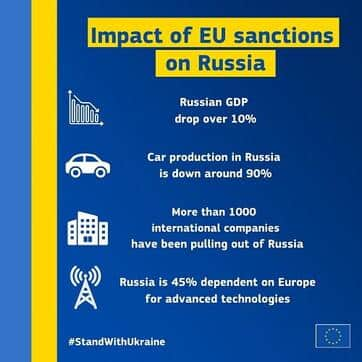
A decrease in Russian GDP of over 10%; a 90% drop in automobile production; more than a thousand international companies out of Russian territory; a halt to the export of advanced European technologies, in which Moscow’s dependence is at 45%.
However, a year later, the Russian economy, however one may think of it, appears to have surpassed gloomy forecasts. By the end of 2022, GDP had shrunk only slightly, inflation had increased but much less than expected, and unemployment was at historic lows, while state coffers had filled with money.
Russia used the proceeds from its gas and oil sales to finance the military campaign (gas and oil sales continued despite sanctions). But more importantly, it began to heavily diversify its exports, finding many emerging and non-emerging countries ready to replace the West.
The Russian invasion of Ukraine represents a blatant and unacceptable violation of international law, and most countries in the world, more than 143 countries, voted in favor of the UN resolution condemning the invasion. At the same time, countries representing 85% of the world’s population have not imposed sanctions on Russia. Neither the United States nor other NATO countries have reflected on why this situation has arisen. Those who, while condemning the invasion, did not sign the sanctions wanted to send a signal that the issue is not so simple and that Russia may have wanted to defend itself against NATO expansion. This situation has thus favored a change in Russia’s partners: what has been set in motion is, in fact, a redesign of international economic relations leading to a new and real “bloc” formed by the BRICS, with other emerging countries in tow. Certainly, Russia will suffer in the medium term from the lack of technology and expertise exchange. But China, India, and others already have significant potential to offer (China has the world’s highest rate of research and development investment as a percentage of GDP).
Western countries, denouncing the unacceptable Russian invasion and the violation of democracy, are finding themselves isolated in a way they could not have imagined even two years ago. Western economic leadership is in question, and economic and political relations with all emerging countries are becoming more difficult. BRICS leaders have proposed expanding the “club” to include countries like Saudi Arabia, Iran, Kazakhstan, Egypt, Algeria, Nigeria, Senegal, Argentina, and Mexico. Already today, their GDP surpasses that of the G7, and it is predicted that by 2050, the “big five” will contribute to more than half of global GDP. These are very different countries, some of them openly and proudly democratic (like India, proud to be “the world’s largest democracy”). However, they do not see the current confrontation between NATO and Russia over Ukraine as a showdown between “democracy” and “autocracy,” and they seem to prefer the diplomatic option of abstention to taking sides.
For many, it seems that the economy matters more than the violation of principles on which no one has an immaculate conscience. Moreover, the West continues to calculate its future prospects as if its technological and military supremacy were eternal. Globalization has enriched the world of emerging countries, and now neither “friendly shoring” (doing business only with friendly countries) as envisioned by Westerners nor sanctions—which also affect those doing business with Russia—seem to scare them. While Westerners now boldly claim that a new cold war has begun and that we are here to fight it, emerging countries seem less afraid, now convinced that the day may have come when they can corner the West.
Authors: Pier Giorgio Ardeni is a full professor of Political Economy and Development at the University of Bologna. Francesco Sylos Labini, a physicist, is a research manager at the E. Fermi Research Center in Rome, co-founder, and editor of Roars
 Francesco sylos labini
Leave a comment