Title: The Tully-Fisher relation and the Bosma effect
Journal: Monthly Notices of the Royal Astronomical Society, Volume 527, Issue 2, January 2024, Pages 2697–2717, https://doi.org/10.1093/mnras/stad3278
Authors: Francesco Sylos Labini, Giordano De Marzo, Matteo Straccamore, and Sébastien Comerón
In this paper, Sylos Labini and collaborators introduce the dark matter disk model, which provides a new interpretation of the dynamics of disk galaxies. The motivation behind this model stems from the observed inconsistency between the observed flat rotation curves of spiral galaxies and the expected Keplerian decline based on the luminous matter in the galactic disk. Traditionally, this discrepancy has led to the conclusion that massive spherical dark halos dominate the gravitational dynamics of spiral galaxies.
The dark matter disk model proposes an alternative scenario where dark matter is primarily located within the galactic disk itself. This hypothesis is supported by the observed correlation between dark matter and the distribution of neutral hydrogen (HI) gas, initially noticed by Albert Bosma in 1981. Specifically, in nearby disk galaxies, it has been observed that the ratio of the total disc surface density (derived from rotation curve measurements) to the gas surface density (measured from HI observations) remains roughly constant beyond a certain distance from the galactic center. This correlation implies that rotation curves at larger radii can be interpreted as rescaled versions of those derived from the HI gas distribution. Consequently, the dark matter is hypothesized to follow the distribution of the gas and confined to a disk, although direct observation of the dark matter distribution in this model is yet to be achieved.
Within the framework of the dark matter disk model, this study demonstrates that the rotation curves of 16 nearby disk galaxies, as well as the Milky Way, can be accurately described. This finding allows for the rescaling of the rotation curves of these galaxies to match a universal slowly decaying profile, providing further support for the dark matter disk model.
Moreover, the dark matter disk model allows for the derivation of a new version of the Tully-Fisher (TF) relation, which is an empirical relationship linking the mass of a disk galaxy to its rotational velocity. The derived TF relation within the dark matter disk model shows good agreement with observational data.
Consistent with this model, estimates of galaxy masses are found to be systematically lower than those obtained assuming a spherical dark matter halo. These findings present theoretical challenges in understanding the dynamical evolution of disk galaxies and highlight the need for further exploration.
From an observational standpoint, the paper discusses several potential tests that can help differentiate between the dark matter disk model and the traditional spherical dark halo model.
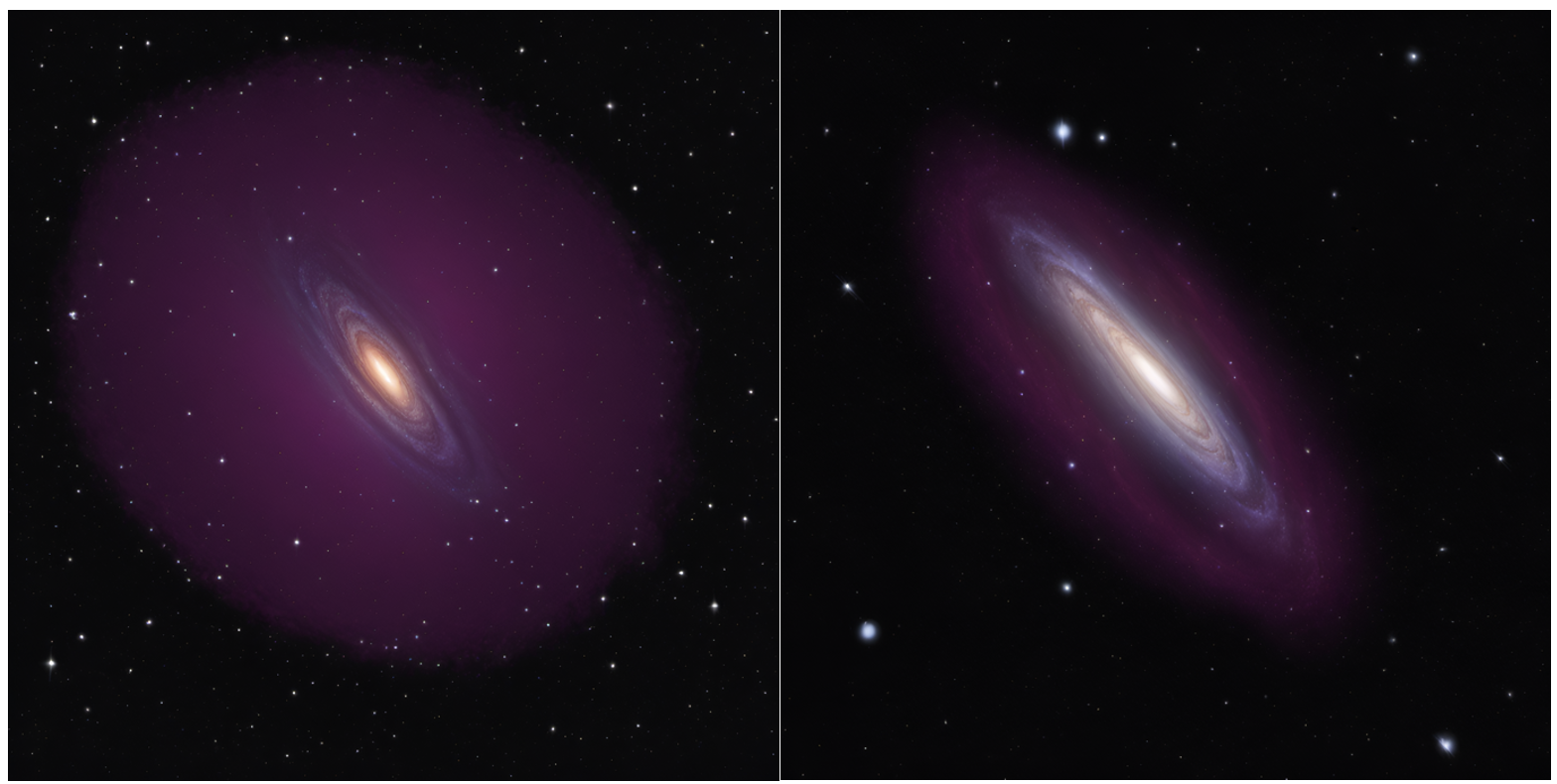
The left panel illustrates the standard halo model, where dark matter is distributed in a spherical halo that surrounds and encompasses a galactic disk. In this model, the dark matter extends throughout the halo region. The right panel depicts the dark matter disk model, where dark matter is confined primarily to the galactic disk and its distribution is traced by the distribution of neutral hydrogen. In this model, the dark matter is concentrated within the disk and its presence is inferred from the observed properties of neutral hydrogen. These two panels visually represent the contrasting assumptions and distributions of dark matter in the two models: the standard halo model assumes a spherical distribution around the galactic disk, while the dark matter disk model proposes that dark matter mainly resides within the disk itself.
 Francesco sylos labini
Leave a comment