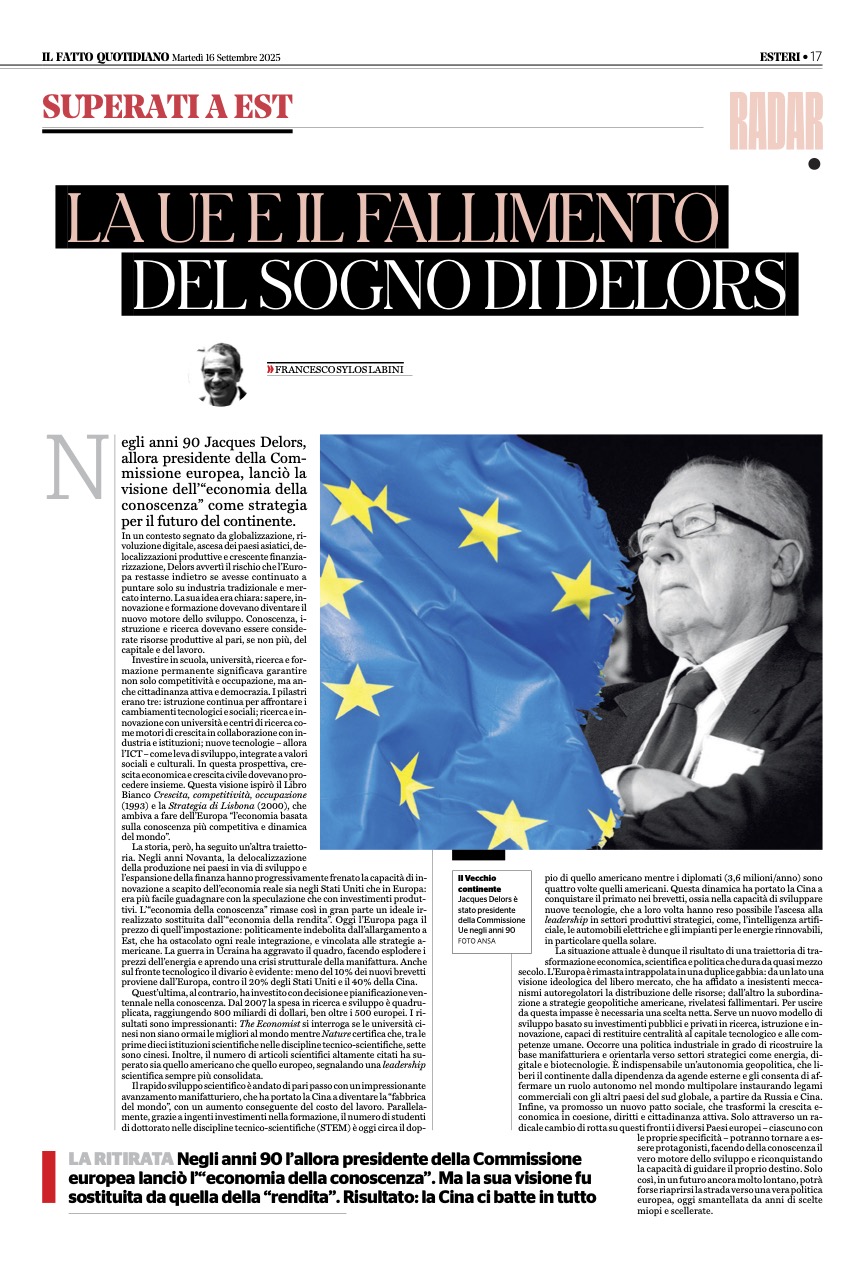
In the 1990s, then–European Commission President Jacques Delors launched the vision of a “knowledge economy” as the strategy for the continent’s future.
Amid globalization, the digital revolution, the rise of Asian economies, offshoring, and growing financialization, Delors warned of the risk that Europe would fall behind if it continued to rely solely on traditional industry and the internal market. His idea was clear: knowledge, innovation, and education had to become the new drivers of development. Education and research were to be considered productive resources on par with, if not more important than, capital and labor.
Investing in schools, universities, research, and lifelong learning meant not only ensuring competitiveness and employment, but also fostering active citizenship and democracy. The strategy rested on three pillars: continuous education to cope with technological and social change; research and innovation with universities and research centers as engines of growth in collaboration with industry and institutions; and new technologies—at the time ICT—as a lever for development, integrated with social and cultural values. In this view, economic and civic growth were to advance together. This vision inspired the White Paper on Growth, Competitiveness, Employment (1993) and the Lisbon Strategy (2000), which aimed to make Europe “the most competitive and dynamic knowledge-based economy in the world.”
History, however, took a different path. In the 1990s, the outsourcing of production to developing countries and the expansion of finance gradually curbed innovation capacity to the detriment of the real economy, both in the United States and in Europe. It was easier to profit from speculation than from productive investment. The “knowledge economy” thus remained largely an unfulfilled ideal, replaced by an “economy of rent.” Today Europe pays the price for that shift: politically weakened by the enlargement to the East, which hindered real integration, and constrained by American strategic priorities. The war in Ukraine has further exacerbated the situation, driving up energy prices and triggering a structural crisis in manufacturing. On the technological front, the gap is stark: less than 10% of new patents come from Europe, compared to 20% from the United States and 40% from China.
China, by contrast, has invested decisively and with long-term planning in knowledge. Since 2007, its spending on research and development has quadrupled, reaching $800 billion—well above Europe’s $500 billion. The results are striking: The Economist wonders whether Chinese universities are now the best in the world, while Nature reports that seven of the top ten institutions in technical and scientific fields are Chinese. Moreover, the number of highly cited scientific papers from China has surpassed both the U.S. and Europe, underscoring its growing scientific leadership.
This scientific boom has gone hand in hand with extraordinary industrial growth, making China the “factory of the world” and raising labor costs. At the same time, thanks to massive investment in education, the number of PhD students in STEM fields is now roughly double that of the U.S., while the number of graduates (3.6 million per year) is four times higher. This dynamic has enabled China to take the lead in patents—that is, in the capacity to develop new technologies—which in turn has fueled its rise to leadership in strategic sectors such as artificial intelligence, electric vehicles, and renewable energy, particularly solar power.
The current situation is the outcome of nearly half a century of economic, scientific, and political transformation. Europe has remained trapped in a double bind: on the one hand, an ideological vision of the free market, entrusting the distribution of resources to non-existent self-regulating mechanisms; on the other, subordination to American geopolitical strategies, which have proved disastrous.
Escaping this impasse requires a clear choice. Europe needs a new development model based on public and private investment in research, education, and innovation, restoring centrality to technological capital and human skills. It needs an industrial policy capable of rebuilding its manufacturing base and steering it toward strategic sectors such as energy, digital technologies, and biotechnology. It must achieve geopolitical autonomy, freeing itself from external agendas and asserting an independent role in a multipolar world, forging commercial ties with the Global South, starting with Russia and China. Finally, a new social pact is needed, one that transforms economic growth into cohesion, rights, and active citizenship.
Only through such a radical change of course can European countries—each with their own specificities—once again become key players, making knowledge the true engine of development and reclaiming the ability to shape their own destiny. Only then, perhaps in a still distant future, might the path reopen toward a genuine European political project, dismantled by years of shortsighted and reckless choices.
 Francesco sylos labini
Leave a comment