In this work, now accepted for publication in The Astrophysical Journal (https://doi.org/10.3847/1538-4357/ae4c3c), we have analyzed the neutral hydrogen (HI) velocity maps of the galaxy ESO 358-60, derived from measurements of the line-of-sight velocity. In these maps, red and blue colors indicate regions where the gas is receding from us or approaching us, respectively. To first order, this pattern can be interpreted as the projection of a rotating disk onto the plane of the sky. The disk is inclined with respect to the line of sight, and its rotation produces the observed velocity gradient. By measuring the line-of-sight component of the velocity across the disk, we can reconstruct the kinematic structure of the galaxy.
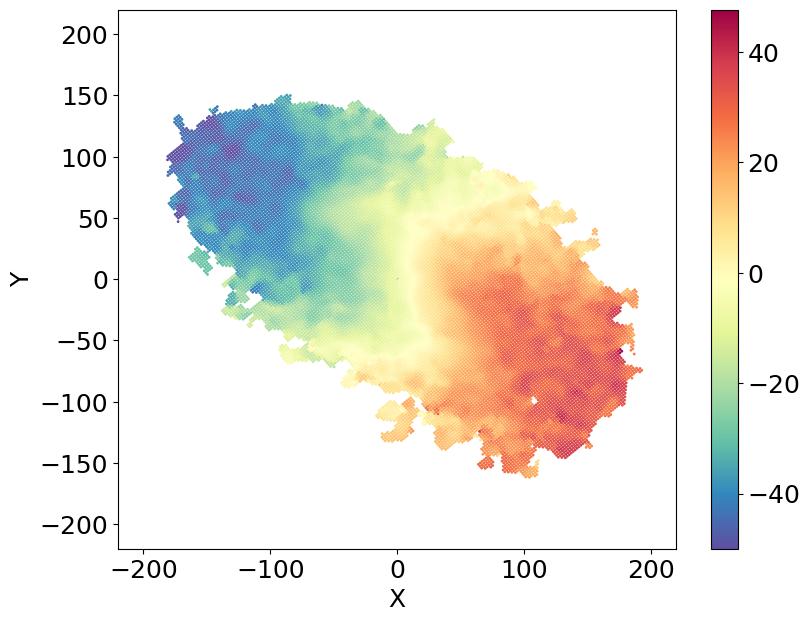
From this map and by using the Velocity Ring Model which is a techinque that we have introduced a few years ago (https://ui.adsabs.harvard.edu/abs/2023MNRAS.524.1560S/abstract), we reconstructed the map of the transversal component of the velocity
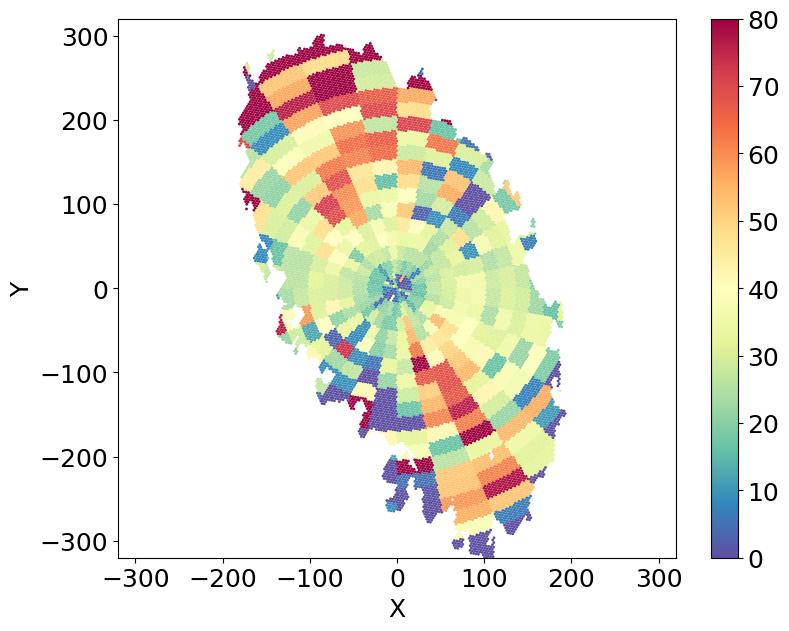
and of the radial component of the velocity
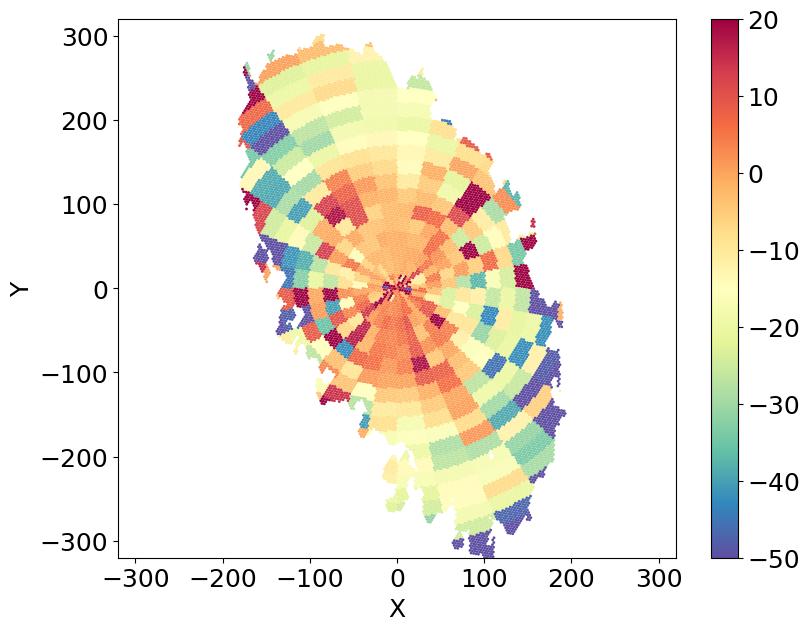
The main information extracted from these velocity maps is that the central region of the galaxy appears to be close to dynamical equilibrium, with matter rotating coherently around the galactic center. In contrast, the outer regions display significant velocity gradients and asymmetries, suggesting the presence of non-equilibrium features, possibly induced by tidal interactions or environmental effects.
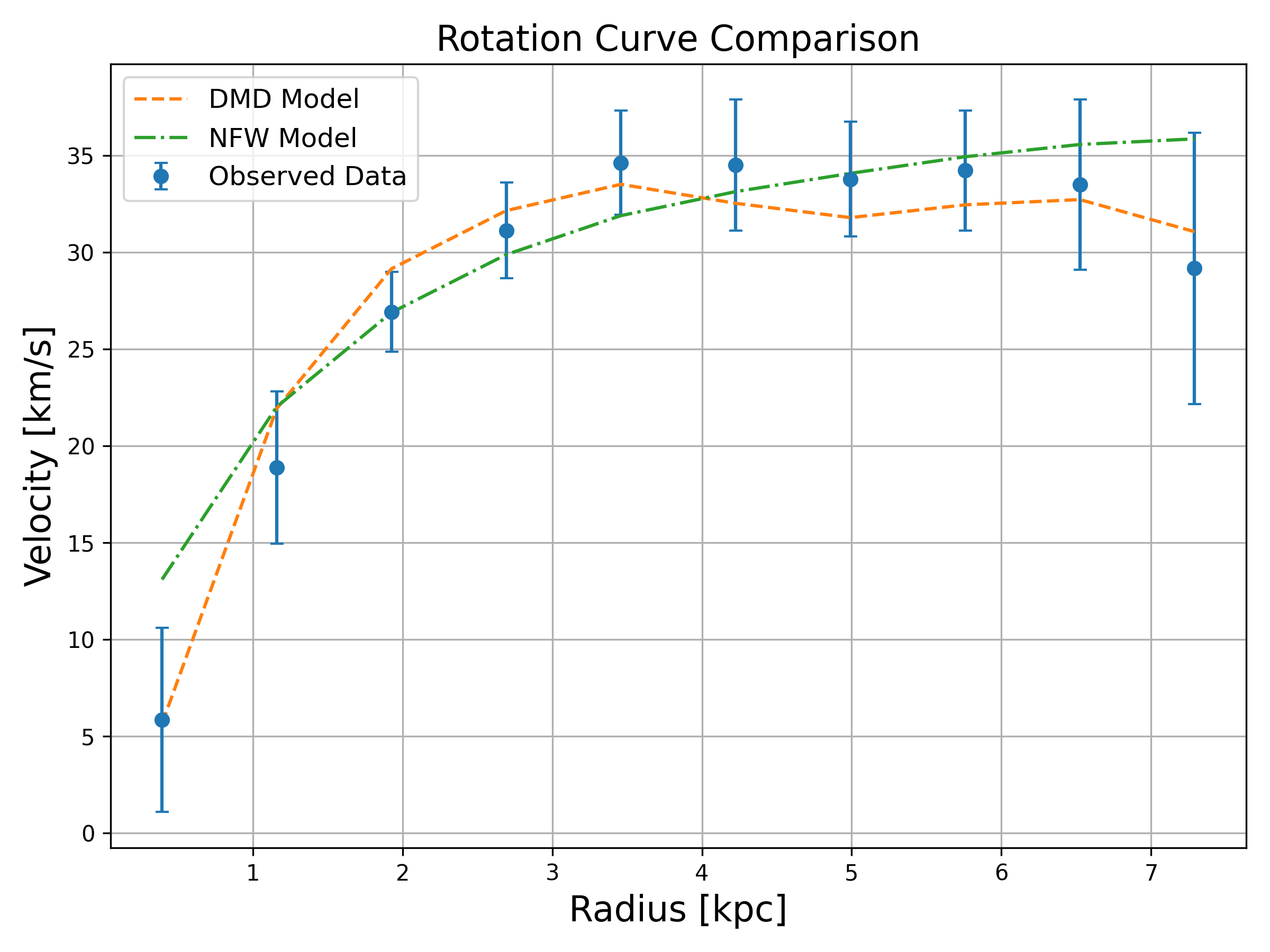
For this reason, we focus our analysis on the central region and fit the observed rotation curve using two alternative mass models: the standard dark matter halo model and the dark matter disk model. In the halo model, the rotationally supported stellar and gaseous disk is embedded within a spherical dark matter halo, whose support arises from an isotropic velocity dispersion and which, by construction, does not participate in the disk rotation. In the dark matter disk model, instead, an additional mass component is assumed to be distributed within the disk itself, following a spatial distribution similar to that of neutral hydrogen. This component is not directly observable in electromagnetic radiation; one possible interpretation is that it consists of very cold clouds of neutral hydrogen that emit negligibly.
From a statistical perspective, the key difference between the two models lies in the number of free parameters. The dark matter disk (DMD) model involves only one free parameter, whereas the standard halo model requires two. Despite its greater simplicity, the DMD model provides a statistically better fit to the observed rotation curve, yielding a more accurate reproduction of the data.
Moreover, the total mass inferred under the DMD model is approximately an order of magnitude smaller than that required by the spherical halo model. This difference is not only statistically significant but also physically relevant, as it implies substantially different dynamical interpretations of the galaxy’s mass distribution.
Thus less dark mass and a more simple mass models where all the matter rotates in the disk.
 Francesco sylos labini
Leave a comment