Tag Archives: Milky Way

Curve di rotazione generalizzate della Via Lattea dai dati del GAIA DR3: vincoli sui modelli di massa

Uno dei grandi problemi dell’astrofisica è capire quanto sia e come sia distribuita la materia oscura. Nel caso della nostra galassia, la Via Lattea, per studiare questo problema si parte delle osservazioni della distribuzione delle stelle e del gas e dal loro campo di velocità.

Grazie ai dati del satellite Gaia è oggi possibile analizzare grandi campioni di stelle in cui è nota sia la posizione tridimensionale di ognuna, che le tre componenti della velocità. Da queste osservazioni si può dunque ricostruire il campo di velocità in tre dimensioni, cioè si può caratterizzare la cinematica della Via Lattea.

Continue reading Curve di rotazione generalizzate della Via Lattea dai dati del GAIA DR3: vincoli sui modelli di massa

Generalized rotation curves of the Milky Way from the GAIA DR3 data-set: constraints on mass models


https://doi.org/10.48550/arXiv.2410.14307

One of the major challenges in astrophysics is understanding how much dark matter exists and how it is distributed. In the case of our galaxy, the Milky Way, to study this problem, we start with observations of the distribution of stars and gas and their velocity field.

Thanks to data from the Gaia satellite, it is now possible to analyze large samples of stars for which both the three-dimensional position and the three components of velocity are known. From these observations, it is possible to reconstruct the velocity field in three dimensions, allowing us to characterize the kinematics of the Milky Way.

To connect kinematics to dynamics, we must assume that the galaxy has reached a steady equilibrium, where stars move in closed circular orbits and the entire system is stable and does not change over time.

Continue reading Generalized rotation curves of the Milky Way from the GAIA DR3 data-set: constraints on mass models

Rotation curves of the Milky Way and of external galaxies and a new mass model


Research Center for Astronomy and Applied Mathematics
of the Academy of Athens 
Webinar: TUESDAY 9 April 2024, 12:00 local time (UTC+3)
Rotation curves of the Milky Way and of external galaxies and a new mass model
Francesco Sylos Labini
Enrico Fermi Research Center, Rome, Italy
Abstract:
  
Continue reading Rotation curves of the Milky Way and of external galaxies and a new mass model

Our results on Scientific American

Slow-moving stars at the Milky Way’s outskirts suggest our galaxy may be far lighter than previously believed, with profound implications for dark matter

The Gaia satellite, which was launched in 2013, offers the best-yet test of this simple notion via the spacecraft’s extraordinarily precise measurements of the three-dimensional positions and motions of stars in the Milky Way. But this testing has been a gradual process because the precision of Gaia’s reckoning improves in lockstep with how long it observes its stellar sample. Using Gaia, theoretical physicist Francesco Sylos Labini of the Enrico Fermi Study and Research Center in Italy and his associates saw subtle hints of a decline in the Milky Way’s stellar speeds a few years ago. Those hints became much more obvious in Gaia’s most recent data release, from 2022, which pegs stellar motions with twice the precision of a previous offering from 2018. Such improvements allow astronomers to plot the paths of stars with greater accuracy and out to much farther distances than before.

Read the complete article on Scientific American

CNR COMUNICATO STAMPA 96/2018: La Via Lattea non è in equilibrio

46310467_10155856872102727_1616626076761456640_oLe stelle della nostra galassia dovrebbero girare intorno al nucleo con un moto di rotazione in equilibrio dinamico. Un team internazionale, cui partecipano ricercatori del Cnr-Isc, analizzando i dati del satellite Gaia, ha ottenuto le più estese mappe di velocità delle stelle della nostra galassia, che mettono in discussione l’ipotesi che le stelle ruotino con soli moti circolari. Sono stati, infatti, rivelati moti radiali e verticali e differenze nella velocità di rotazione in diverse zone stellari. Lo studio, pubblicato su Astronomy and Astrophysics, induce a rivedere anche le stime sulla materia oscura

Continue reading CNR COMUNICATO STAMPA 96/2018: La Via Lattea non è in equilibrio

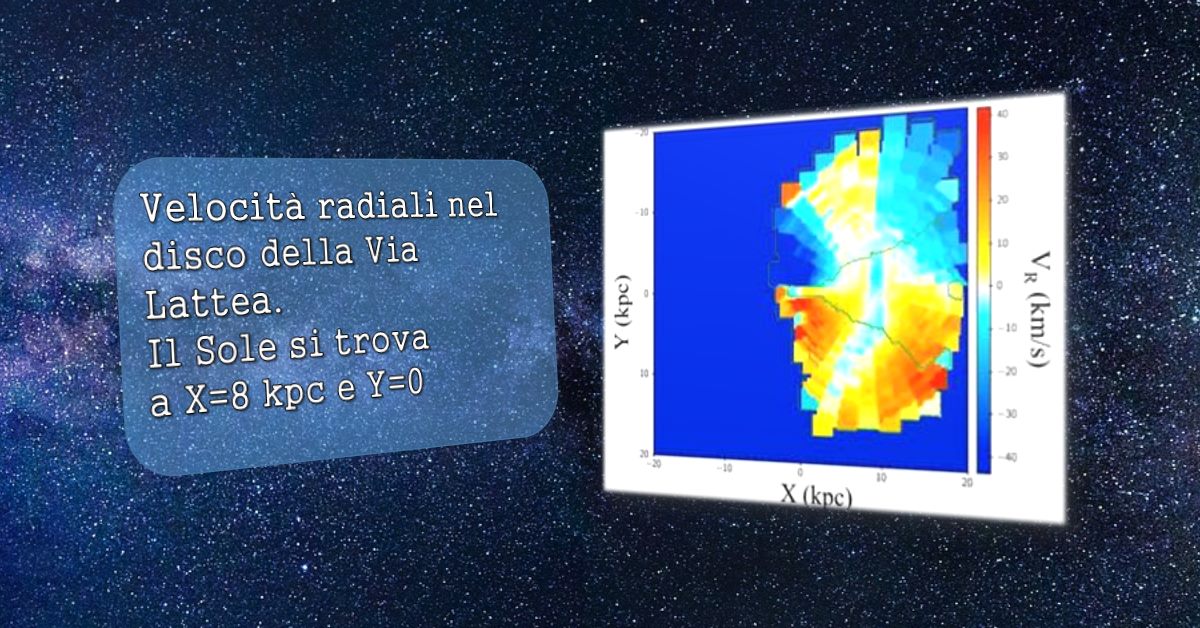
Gaia-DR2 extended kinematical maps. Part I: Method and application

Fig8a
CONTEXT. The Gaia Collaboration has used Gaia-DR2 sources with six-dimensional (6D) phase space information to derive kinematical maps within 5 kpc of the Sun, which is a reachable range for stars with relative error in distance lower than 20%.
AIMS. Here we aim to extend the range of distances by a factor of two to three, thus adding the range of Galactocentric distances between 13 kpc and 20 kpc to the previous maps, with their corresponding error and root mean square values.
METHODS. We make use of the whole sample of stars of Gaia-DR2 including radial velocity measurements, which consists in more than seven million sources, and we apply a statistical deconvolution of the parallax errors based on the Lucy’s inversion method of the Fredholm integral equations of the first kind, without assuming any prior.
RESULTS. The new extended maps provide lots of new and corroborated information about the disk kinematics: significant departures of circularity in the mean orbits with radial Galactocentric velocities between -20 and +20 km/s and vertical velocities between -10 and +10 km/s; variations of the azimuthal velocity with position; asymmetries between the northern and the southern Galactic hemispheres, especially towards the anticenter that includes a larger azimuthal velocity in the south; and others.
CONCLUSIONS. These extended kinematical maps can be used to investigate the different dynamical models of our Galaxy, and we will present our own analyses in the forthcoming second part of this paper. At present, it is evident that the Milky Way is far from a simple stationary configuration in rotational equilibrium, but is characterized by streaming motions in all velocity components with conspicuous velocity gradients.
Comments: 19 pages, 16 figures, accepted to be published in Astronomy and Astrophysics in the press; data of Figs. 8-12 and 16 publicly available
Subjects: Astrophysics of Galaxies (astro-ph.GA)
Cite as: arXiv:1810.13436 [astro-ph.GA]
(or arXiv:1810.13436v1 [astro-ph.GA] for this version)