Tag Archives: Science

Exploring the Dark Matter Disc Model in Dwarf Galaxies: Insights from the LITTLE THINGS Sample

Francesco Sylos LabiniRoberto Capuzzo-DolcettaGiordano De MarzoMatteo Straccamore

ABSTRACT We conducted an analysis of the velocity field of dwarf galaxies in the LITTLE THINGS sample, focusing on deriving 2D velocity maps that encompass both the transverse and radial velocity fields. Within the range of radial distances where velocity anisotropies are sufficiently small for the disc to be considered rotationally supported, and where the warped geometry of the disc can be neglected, we reconstructed the rotation curve while taking into account the effect of the asymmetric drift. To fit the rotation curves, we employed the standard halo model and the dark matter disc (DMD) model, which assumes that dark matter is primarily confined to the galactic discs and can be traced by the distribution of HI. Interestingly, our analysis revealed that the fits from the DMD model are statistically comparable to those obtained using the standard halo model, but the inferred masses of the galaxies in the DMD model are approximately 10 to 100 times smaller than the masses inferred in the standard halo model. In the DMD model, the inner slope of the rotation curve is directly related to a linear combination of the surface density profiles of the stellar and gas components, which generally exhibit a flat core. Consequently, the observation of a linear relationship between the rotation curve and the radius in the disc central regions is consistent with the framework of the DMD model.

Continue reading Exploring the Dark Matter Disc Model in Dwarf Galaxies: Insights from the LITTLE THINGS Sample

Generalized rotation curves of the Milky Way from the GAIA DR3 data-set: constraints on mass models


https://doi.org/10.48550/arXiv.2410.14307

One of the major challenges in astrophysics is understanding how much dark matter exists and how it is distributed. In the case of our galaxy, the Milky Way, to study this problem, we start with observations of the distribution of stars and gas and their velocity field.

Thanks to data from the Gaia satellite, it is now possible to analyze large samples of stars for which both the three-dimensional position and the three components of velocity are known. From these observations, it is possible to reconstruct the velocity field in three dimensions, allowing us to characterize the kinematics of the Milky Way.

To connect kinematics to dynamics, we must assume that the galaxy has reached a steady equilibrium, where stars move in closed circular orbits and the entire system is stable and does not change over time.

Continue reading Generalized rotation curves of the Milky Way from the GAIA DR3 data-set: constraints on mass models

Rotation curves of the Milky Way and of external galaxies and a new mass model


Research Center for Astronomy and Applied Mathematics
of the Academy of Athens 
Webinar: TUESDAY 9 April 2024, 12:00 local time (UTC+3)
Rotation curves of the Milky Way and of external galaxies and a new mass model
Francesco Sylos Labini
Enrico Fermi Research Center, Rome, Italy
Abstract:
  
Continue reading Rotation curves of the Milky Way and of external galaxies and a new mass model

La pandemia come il terremoto non si prevede, ma si monitora

La ricerca scientifica è stata a lungo trascurata in termini di finanziamento, attenzione politica, importanza pubblica e culturale. La pandemia ha cambiato questa situazione: il valore della ricerca è stato riconosciuto, i finanziamenti sono stati annunciati e i ricercatori sono alla ribalta. Tuttavia, questa nuova situazione non è priva di pericoli. A volte gli scienziati intervistati in qualche talk show si allontanano dalla loro area di competenza, come quando i virologi parlano di epidemiologia, i biologi di politica sanitaria e così via. Per questo, gli scienziati hanno spesso diversi punti di vista su argomenti che sono lontani dal proprio dominio professionale: questo non è sorprendente, ma può confondere l’opinione pubblica che considera gli scienziati come i detentori della verità ultima. Come è possibile che ci siano molte verità “ultime” a volte opposte? Continue reading La pandemia come il terremoto non si prevede, ma si monitora

Italy wakes up to science

italy_map-738x443Pandemic should prompt discussion of what research can and can’t do, says Francesco Sylos Labini
Research has long been overlooked in Italy­­—financially, politically and culturally. But the Covid-19 pandemic has changed all that. The value of research is now being recognised, with funding announced and researchers experiencing a new prominence. This new relationship between science, politics and the media is not without its dangers, though.

The media is unaccustomed to explaining and scrutinising the technicalities of epidemiology and public health. In interviews, researchers are sometimes tempted to stray beyond their area of expertise, and politicians can be tempted to shift the blame for policy missteps onto scientific advice and the researchers who provide it. Throw differing scientific viewpoints into the mix, and it is not surprising the public may sometimes be confused—especially if scientists are portrayed as, or expected to be, the arbiters of ultimate truth.

The pandemic has highlighted the need for Italy to take a nationwide crash course in epistemology. In particular, scientists—and the media and policymakers—need to be clear about what science can and can’t do. This is particularly the case when scientific predictions are informing policy decisions.

  Continue reading Italy wakes up to science

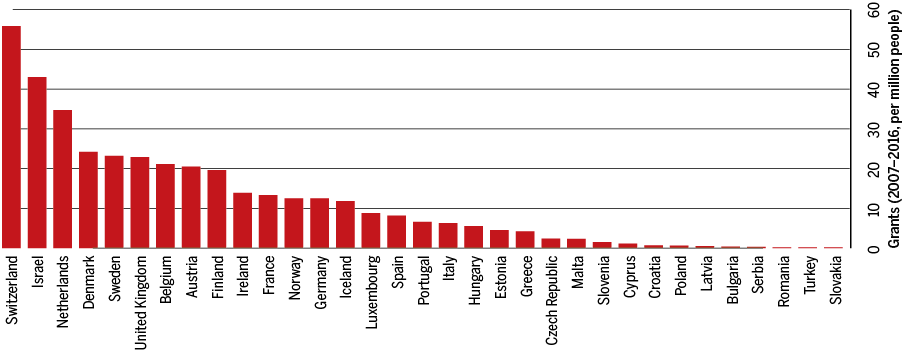
At 10, Europe’s ‘excellence’ fund faces calls for change

OnlineVersion_ERC350

Per il decennale di fondazione del programma ERC sono stato intervistato su Science. Qui di seguito un pezzo dell’articolo. Brevemente ci sono due tipi di problemi per il programma ERC. Il primo politico e in sintesi riguarda il fatto di mascherare scelte politiche (come distribuire i fondi) con un meccanismo pseudo-tecnico (premiamo l’eccellenza). Il secondo scientifico riguarda il fatto che l’eccellenza di domani non si premia dando i fondi all’eccellenza di ieri. E comunque non si premia dando fondi al top 5% (di quelli che applicano) selezionati in base a effetti di rumore statistico. Infine sempre sul piano politico c’è il fatto di dare un esempio sbagliato per le politiche scientifiche nazional. Per maggiori dettagli rimando al mio libro, a questo articolo  e a quest’altro articolo . Continue reading At 10, Europe’s ‘excellence’ fund faces calls for change